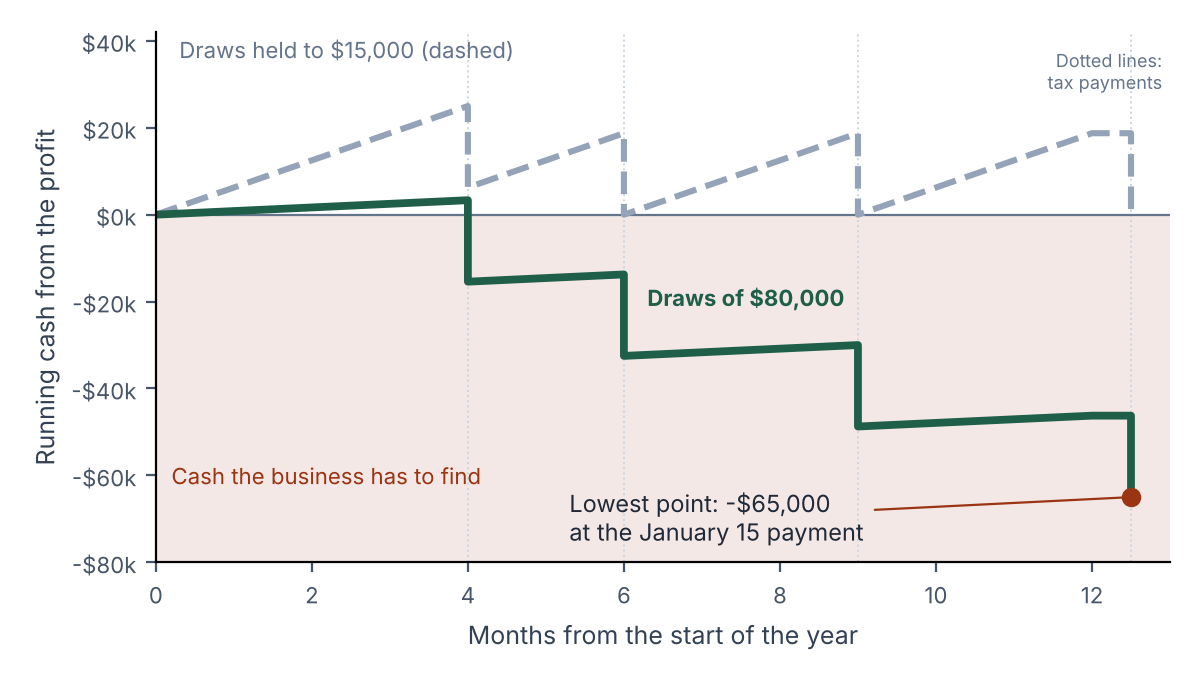
A $300,000 profit is generally taxed whether or not it arrived as cash. Paying the $75,000 tax on time while drawing $80,000 leaves the business $65,000 below zero at the January 15 payment; holding draws to $15,000 keeps cash at zero or above but leaves the owner $65,000 less to take home. The question is whether the $65,000 can be funded.
| Step | Amount | Cash left after it |
|---|---|---|
| Net profit on the return | $300,000 | $300,000 |
| Loan principal paid | -$90,000 | $210,000 |
| Inventory bought, not yet sold | -$70,000 | $140,000 |
| Invoices sent, not yet paid | -$50,000 | $90,000 |
| Owner draws | -$80,000 | $10,000 |
| Tax on the profit (assumed 25 percent) | -$75,000 | -$65,000 |
| Total outflows, five steps | -$365,000 | -$65,000 short |
The amount to find is the shortfall after the tax, not the profit. The profit is on the return; the cash is in the bank.
Illustration, not a tax calculation. The inputs and their basis are under "How this example is built" at the end.
When the tax is paid
| When | Tax paid | Cash, draws of $80,000 | Cash, draws held to $15,000 |
|---|---|---|---|
| Start of the year | $0 | $0 | $0 |
| Payment 1, end of month 4 | $18,750 | -$15,417 | $6,250 |
| Payment 2, end of month 6 | $18,750 | -$32,500 | $0 |
| Payment 3, end of month 9 | $18,750 | -$48,750 | $0 |
| End of year, before January 15 | $0 | -$46,250 | $18,750 |
| Payment 4, January 15 | $18,750 | -$65,000 | $0 |
The lowest point is the January 15 payment, a Friday in 2027. The IRS dates for the first three are April 15, June 15 and September 15; the table uses month ends.
What shrinks the shortfall
| Change, one at a time | Still short | Change |
|---|---|---|
| As modelled | $65,000 | none |
| Half the unpaid invoices ($25,000) collected first | $40,000 | +$25,000 |
| Draws held to what is left after tax ($15,000) | $0 | +$65,000 |
These move cash; none changes the tax. The last row is the number to reuse: cash before draws ($90,000) minus the tax ($75,000) leaves $15,000 for draws, the dashed line above.
What a worse year does
| Case | Tax | Still short | Room for draws after the tax |
|---|---|---|---|
| As modelled | $75,000 | $65,000 | $15,000 |
| Tax at 30 percent instead of 25 percent | $90,000 | $80,000 | $0 |
| Both | $90,000 | $105,000 | -$25,000 |
A negative room means the shortfall remains even with no draws.
What the estimated tax rules ask for
| Penalty rule, generally | Amount in the example | Left to pay with the return |
|---|---|---|
| 90 percent of this year's tax | $67,500 | $7,500 |
| 110 percent of last year's tax (assumed $60,000; adjusted gross income assumed over $150,000) | $66,000 | $9,000 |
The smaller of the two avoids the penalty, here $66,000; it does not reduce the tax. Ask the CPA which rule fits.
What borrowing the shortfall costs
Interest of $1,300 to $1,950 against a $65,000 shortfall is small, so the decision turns on whether the cash can be had, not on the rate.
| Annual rate | Cash to find | Interest, 3 months |
|---|---|---|
| 8 percent | $65,000 | $1,300 |
| 10 percent | $65,000 | $1,625 |
| 12 percent | $65,000 | $1,950 |
| Line of credit sized to | Amount | Against the shortfall | Interest at 10 percent for 3 months |
|---|---|---|---|
| The 30 percent tax shortfall | $80,000 | Covers that case with nothing spare | $2,000 |
| The worst case above | $105,000 | Covers every case in the table | $2,625 |
When the other choice is right
| Keep the draws as taken when | Hold draws back when |
|---|---|
| Cash or a credit line the bank has approved covers the shortfall, including the worst case above | No cash or credit covers it, so the tax would be paid from borrowed or late money |
| The CPA expects a lower tax than the assumed 25 percent | The draws were more than what is left after the tax |
Before the January 15 payment
Ask the CPA for the tax on a full year at the current pace and which payments and penalty rule fit. A controller builds the monthly profit to cash bridge and sets the tax aside before draws.
Each month, set aside the tax on the year's profit so far before you pay any draw, and size draws by what is left. In the example that is $90,000 of cash before draws less $75,000 of tax, so $15,000 for draws against the $80,000 taken. The profit-cash diagnostic takes about three minutes; draw rules are in owner draws vs payroll salary.
Where the tax facts come from
| What the IRS page says | Page, and when it was reviewed |
|---|---|
| "sole proprietors, partners, and S corporation shareholders, generally have to make estimated tax payments if they expect to owe tax of $1,000 or more" | IRS, Estimated taxes, 25-Sep-2026 |
| "at least 90% of the tax for the current year or 100% of the tax shown on the return for the prior year, whichever is smaller" | IRS, Topic no. 306, 24-Sep-2026 |
| "If your adjusted gross income (AGI) for 2023 was more than $150,000 ($75,000 if your filing status for 2024 is married filing separately), substitute 110% for 100%" | IRS, Underpayment of estimated tax by individuals penalty, 20-Aug-2026 |
| "Jan. 15 of the following year" | IRS, Estimated tax questions, fourth period (earlier three: April 15, June 15, Sept. 15), 16-Oct-2026 |
| "you may be liable for tax on your share of the partnership income, whether or not distributed" | IRS, Schedule K-1 (Form 1065) partner instructions, 2025 |
The weekday of January 15, 2027 is calendar arithmetic. The K-1 line is partnership wording; S corporation shareholders generally are taxed the same way, which that page does not say, so the CPA confirms it.
How this example is built
| Input | Value | Basis |
|---|---|---|
| Net profit | $300,000 | S corporation, passed through to one owner |
| Loan principal | $90,000 | $9,000 a month is $108,000 a year; $18,000 is interest, already in the profit |
| Inventory growth | $70,000 | Not yet sold |
| Unpaid invoices | $50,000 | Revenue when sent (accrual), unpaid |
| Owner draws | $80,000 | Assumed |
| Tax | $75,000 | An assumed 25 percent, federal and state; not a calculation |
| Last year's tax | $60,000 | Adjusted gross income assumed over $150,000 |
| Timing | Cash accrues evenly; four tax payments of $18,750 | Months 4, 6 and 9 for simplicity; the fourth is January 15, 2027 |
| Cases and rates | Tax at 30 percent; unpaid invoices $25,000 higher; borrowing at 8, 10 and 12 percent for 3 months | Assumed |
This article is informational and does not constitute financial, legal, or tax advice. Consult a qualified professional for decisions specific to your situation.