A customer asking for net 60 instead of net 30 on a $28,000 invoice, and already paying 12 days late, adds about $242 of carrying cost per invoice, $2,940 a year, and cuts the contribution to $2,480 against a $2,600 floor. Refusing gives up $3,060 per invoice, about $37,230 a year. The longest term the job can carry is net 45, which clears the floor by $1.
The free payment terms cost calculator runs the same math on your own invoice, with every field blank until you fill it.
| What the invoice does | Days money is out | Carrying cost per invoice | Contribution left of $3,060 | Against the $2,600 floor |
|---|---|---|---|---|
| Net 30, paid on the due date | 30 | $242 | $2,818 | Clears by $218 |
| Today: net 30, paid at 42 days | 42 | $338 | $2,722 | Clears by $122 |
| Net 45, same 12 days late | 57 | $459 | $2,601 | Clears by $1 |
| Net 60, same 12 days late | 72 | $580 | $2,480 | Short by $120 |
| Net 60, paid 30 days late | 90 | $725 | $2,335 | Short by $265 |
What a term costs is the days your money is out, and the terms and any lateness add together: net 60 with the customer 12 days late is 72 days.
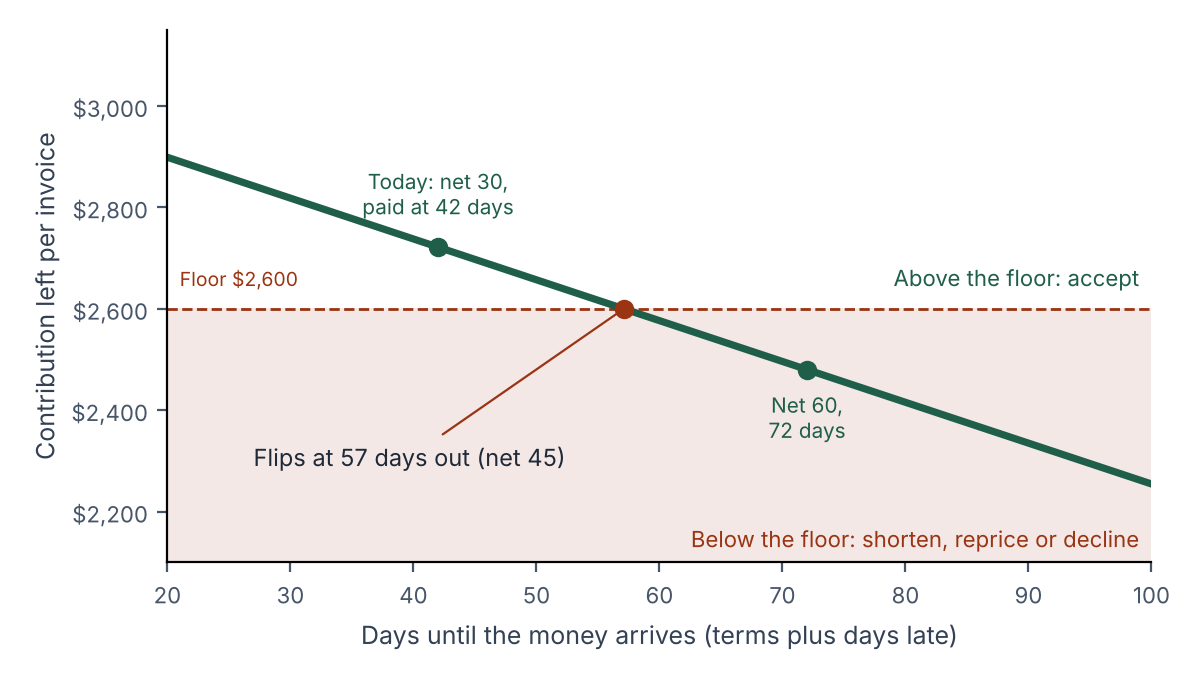
Illustration, not a benchmark. The inputs and their basis are under "How this example is built" at the end.
What moves the answer
| Change, one at a time | Result per invoice | Basis |
|---|---|---|
| Ask for net 45 instead of net 60 | Contribution left $2,601, clears the floor by $1 | 45 days plus 12 days late = 57 days out |
| Net 46 | Contribution left $2,593, short by $7 | The floor flips at 57.1 days out, so net 45 is the longest term that holds |
| Keep net 60 and raise the price 0.44 percent ($122 on the invoice) | Contribution left meets the $2,600 floor | The carrying cost also grows with the price, so the rise is solved, not guessed |
| Same terms, but the customer pays 30 days late | Net 60 becomes 90 days out, contribution left $2,335 | Table above |
| If the cost of money is | The floor flips at (days money is out) | Longest term that holds with 12 days late |
|---|---|---|
| 8 percent a year | 75 | net 62 |
| 10.5 percent a year | 57 | net 45 |
| 13 percent a year | 46 | net 34 |
Terms that cost more than the job's contribution can spare are repriced, shortened or declined; a longer term is only free when the price already carries it.
Discounts for paying early
| Discount offered | Days earlier the cash arrives | Annual rate it costs the seller |
|---|---|---|
| 1/10 net 30 | 20 | 18 percent |
| 2/10 net 30 | 20 | 37 percent |
| 3/10 net 30 | 20 | 56 percent |
| 2/10 net 45 | 35 | 21 percent |
| 2/10 net 60 | 50 | 15 percent |
A discount is worth giving when the rate it costs is below the owner's cost of money, and only if the customer pays inside the window. A customer who takes the discount and pays late anyway has cost the owner both.
| One discount worked through | Figure | Basis |
|---|---|---|
| Invoice | $9,600 | Illustration: net 45, the customer pays at 70 days |
| Discount offered | 1.5 percent for paying in 15 days = $144 | Invoice times the discount |
| Days of waiting it removes | 55 | 70 days paid today minus 15 |
| Carrying cost saved at 13 percent | $188 | Invoice times rate times 55 days over 365 |
| Annual rate the discount costs | 10.1 percent | Against 13 percent: cheaper than waiting |
| Net per invoice | +$44 in the seller's favour | Saved minus the discount |
When the clock starts
| Same invoice, dated the 5th of a 31-day month | Days until due | Carrying cost |
|---|---|---|
| Net 30, counted from the invoice date | 30 | $242 |
| Net 30 end of month, counted from the month's end | 56 | $451 |
"Net 30" and "net 30 end of month" are different terms. Read which one the contract says before pricing it.
When the other choice is right
| Accept the longer terms when | Refuse or reprice when |
|---|---|
| Contribution left stays above the floor at the days the customer really pays | It falls below the floor, as at net 60 here |
| The customer has paid on time for the last several invoices | The customer already pays late and the terms would add to it |
| The price already carries the extra days | Nothing in the price covers the wait |
| The owner's cash is idle or cheap, so waiting costs little | Waiting is financed on a line at the rates above |
Before signing
- Tax: the figures are before tax. Ask the accountant how interest paid and discounts given are treated, then compare the choices after tax.
- Contract terms: the wording of the due date, late fees and discounts is the contract's, not this page's. Ask a business attorney to read it.
- Who does what: the bookkeeper pulls actual days to pay from the aging report; the controller sets the floor from job costs.
Next time a customer asks for longer terms, add the days they really take to pay to the term, price those days at your cost of money, and see whether what is left still clears the least the job must earn.
To run a customer's own numbers, use the payment terms calculator. If it is unclear whether late payers are the cash problem, the profitable-but-out-of-cash diagnostic takes about three minutes. For a 1:1 review, email [email protected] with the invoice amount, payment terms, current cash and credit line.
How this example is built
| Input | Value | Basis |
|---|---|---|
| Invoice | $28,000 | Illustration; one invoice every 30 days |
| Contribution | $3,060 per invoice | Illustration: the invoice less direct job costs, before overhead |
| Floor | $2,600 per invoice | Illustration: the least contribution the owner will accept |
| Cost of money | 10.5 percent a year | Illustration: a line-of-credit rate, not a quote; 8 and 13 percent shown for comparison |
| Days late | 12 | Illustration: the customer pays 12 days after the due date and keeps doing so |
| Carrying cost | Invoice x rate x days out / 365 | Cash waited for, priced at what the owner's own cash costs |
| Outside figures | None | No government, wage or competitor figure is used |
This article is informational and does not constitute financial, legal, or tax advice. Consult a qualified professional for decisions specific to your situation.